Finanace and Ecommerce / 23 min read · English
How to Start Freelancing With No Experience: Step-by-Step Guide
Want to start freelancing but have no experience or clients? This practical beginner's guide shows you how to choose a skill, build a portfolio from scratch, find legitimate opportunities, set your rates, and land your first freelance project.
Selectory editorial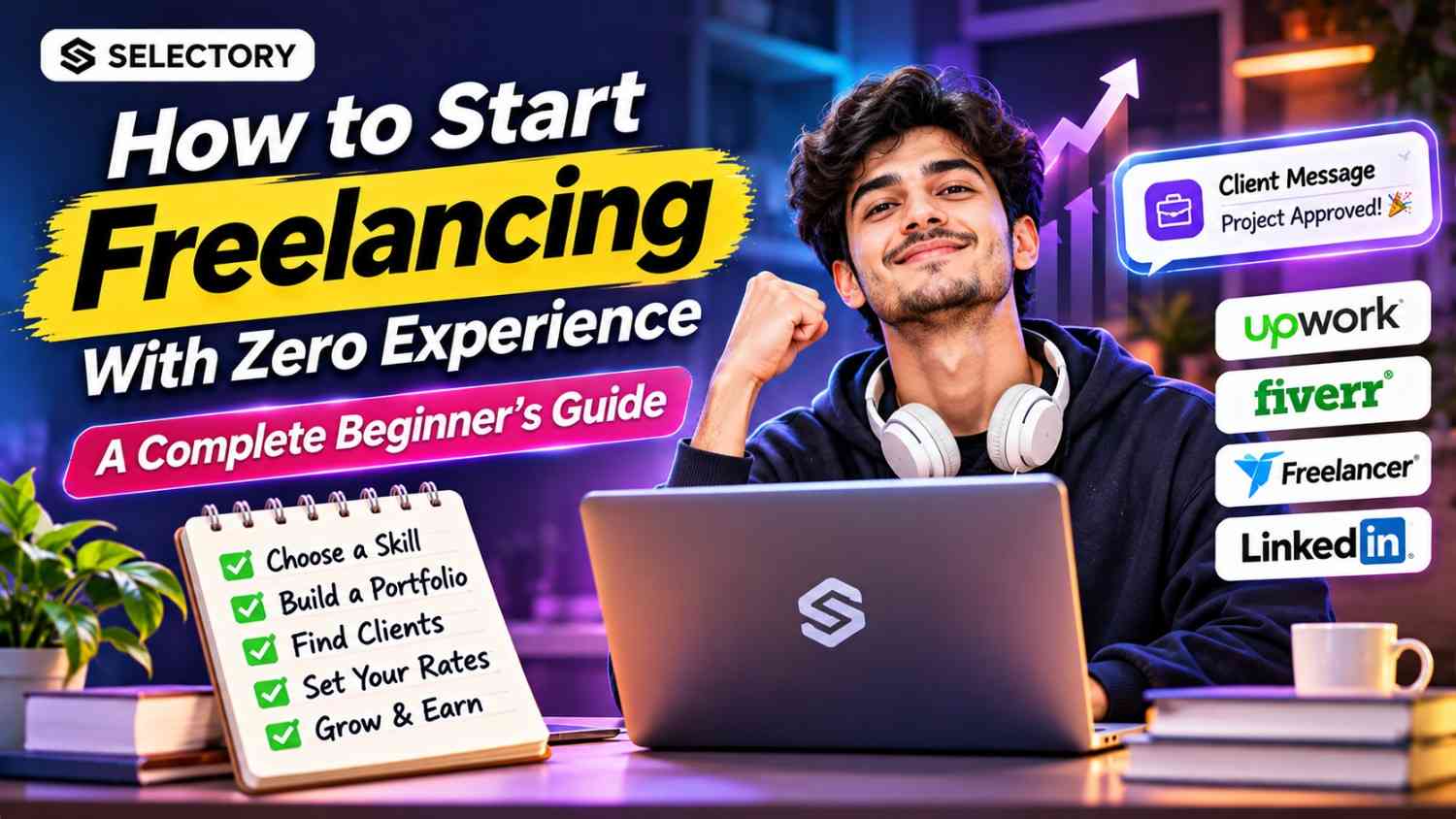
How to Start Freelancing With Zero Experience: A Complete Beginner's Guide
You want to start freelancing.
You open a freelance marketplace, browse available projects, and notice something frustrating:
Clients want experience. But how do you gain experience when nobody has hired you yet?
This is one of the biggest challenges beginners face.
Here's the good news: you don't need a long employment history, an expensive degree, or a list of previous clients to begin freelancing.
You need a useful skill, evidence that you can do the work, a clear service offer, and a reliable way to reach potential clients.
Your first portfolio doesn't even need to contain paid projects.
The goal isn't to look like an experienced freelancer. It's to demonstrate that you can solve a specific problem.
In this guide, you'll learn how to choose your first freelance skill, create portfolio samples, find legitimate clients, set your prices, communicate professionally, and build a sustainable freelance career.
1. What Is Freelancing?
Freelancing means providing services independently to clients, usually on a project, contract, or ongoing basis.
Instead of working exclusively as a permanent employee, you offer a skill that individuals or businesses need.
Common Freelance Services
| Category | Example Services |
|---|---|
| Writing | Blog articles, product descriptions, editing |
| Graphic Design | Social media graphics, presentations, thumbnails |
| Video Editing | Short videos, subtitles, promotional clips |
| Virtual Assistance | Scheduling, research, document organization |
| Web Development | Landing pages, website fixes |
| Data Services | Spreadsheet cleanup, data organization |
| Marketing | Email newsletters, content calendars |
| Translation | Translation, localization, proofreading |
| AI-Assisted Work | Content workflows, research organization, automation setup |
Freelancers can work with one client or multiple clients, depending on their contracts and availability.
Freelancing vs Traditional Employment
| Freelancing | Traditional Employment |
|---|---|
| Often project-based | Usually role-based |
| Income may vary | Often fixed salary |
| Find or negotiate with clients | Employer assigns work |
| Manage your own schedule within deadlines | Schedule often set by employer |
| Handle your own business administration | Employer typically handles payroll |
| No guaranteed ongoing projects | Employment terms may offer greater continuity |
Important: Freelancing offers flexibility, but it also involves uncertainty, client management, taxes, deadlines, and the responsibility of finding work.
2. Can You Start Freelancing With No Experience?
Yes, but you still need to demonstrate competence.
There's a difference between having no professional experience and having no useful skills.
For example:
A student who creates excellent presentation slides may already have a skill businesses need, even without having worked for a paying client.
Similarly, someone who can edit clear, engaging short videos may be able to offer a beginner-level video editing service.
What Clients Actually Need
Most clients are trying to answer questions such as:
- Can this person complete my project?
- Do they understand my requirements?
- Can they show examples of their work?
- Will they communicate reliably?
- Can they deliver on time?
Your job is to make those answers easier.
The Beginner Freelancing Formula
You don't need to master ten skills. Start by becoming useful at one specific service.
3. Choose the Right Freelance Skill
One of the most common beginner mistakes is trying to offer everything.
A profile that says:
"I do writing, coding, design, marketing, editing, SEO, and virtual assistance"
can be less convincing than a focused offer.
Beginner-Friendly Freelance Skills
| Skill | Example Deliverable | Useful Starting Tools |
|---|---|---|
| Social Media Design | Instagram post templates | Canva |
| Video Editing | Short promotional video | CapCut, DaVinci Resolve |
| Content Writing | Helpful blog article | Google Docs |
| Presentation Design | 10-slide presentation | Google Slides |
| Spreadsheet Organization | Clean, formatted spreadsheet | Google Sheets |
| Virtual Assistance | Organized research document | Google Workspace |
| Basic Web Design | One-page website | Google Sites |
| Transcription | Corrected transcript | Suitable transcription tools |
Some tools have free plans or free versions with restrictions. Always check current licensing, export, and commercial-use terms.
How to Choose Your First Skill
Ask yourself three questions:
- Interest: Can I practice this consistently?
- Ability: Can I produce a useful result?
- Demand: Can I identify people or businesses that need this service?
Example
Suppose you enjoy visual design.
Instead of advertising yourself as a general graphic designer, start with:
"I create professional Instagram carousel designs for educational brands."
This is a more specific offer.
It tells potential clients what you create and who it's for.
Skill Selection Scorecard
Rate each skill from 1 to 5.
| Factor | Social Media Design | Video Editing | Writing |
|---|---|---|---|
| Personal interest | 5 | 4 | 3 |
| Current ability | 4 | 2 | 4 |
| Ease of practicing | 5 | 3 | 5 |
| Ability to show samples | 5 | 5 | 4 |
| Total | 19 | 14 | 16 |
Illustrative scores only. Use your own assessment.
Choose one skill to explore first rather than treating this example as a universal ranking.
4. Learn Your Skill Without Buying an Expensive Course
You don't necessarily need a paid course to get started.
Free documentation, tutorials, practice exercises, and public educational resources can help you learn.
Useful Learning Resources
| Platform | What You Can Learn |
|---|---|
| YouTube | Tutorials and demonstrations |
| freeCodeCamp | Programming and web development |
| Canva Design School | Design concepts and tutorials |
| Google Skillshop | Selected Google tools and marketing skills |
| Microsoft Learn | Microsoft technology and productivity skills |
| GCFGlobal | Computer and workplace skills |
A Simple Learning Method
Use this cycle:
Learn → Practice → Review → Improve
For example, if you're learning video editing:
- Watch a tutorial about cuts and transitions.
- Create a 30-second practice video.
- Compare it with professional examples.
- Identify what looks weak.
- Improve the next version.
Avoid spending weeks watching tutorials without creating anything.
Your portfolio grows when you practice, not when you only consume lessons.
5. Build a Freelance Portfolio Without Clients
This is one of the most important steps.
A portfolio is a collection of work samples that demonstrate your abilities.
And yes, you can build one without previous paid projects.
Method 1: Create Personal Projects
Suppose you want to become a social media designer.
Create sample posts for an imaginary coffee shop.
Your portfolio could include:
- A promotional post
- A product announcement
- A five-slide carousel
- A seasonal campaign graphic
Clearly label these as concept projects.
Method 2: Redesign a Sample
Take an existing design problem and create your own solution.
For example:
"How could a restaurant menu become easier to read?"
Show your proposed redesign and explain your decisions.
Don't imply the restaurant hired you.
Respect copyrights, trademarks, and third-party assets.
Method 3: Solve a Real Problem
Find a genuine problem you can address.
Examples:
- Organize a confusing spreadsheet.
- Create a clearer event presentation.
- Improve the readability of a document.
- Edit a short video from footage you have permission to use.
Method 4: Create a Mini Case Study
A case study explains the problem, your approach, and the outcome.
Example Portfolio Case Study
Project: Instagram Carousel for a Fictional Fitness Brand
Problem: Explain beginner workout tips in a visually engaging format.
My Approach:
- Identified the target audience.
- Created a simple content outline.
- Designed five carousel slides.
- Used consistent typography and spacing.
- Exported mobile-friendly graphics.
Deliverables:
- Five carousel images
- Editable source design
- Short design explanation
Result: A complete concept campaign demonstrating visual communication skills.
Notice that the case study doesn't invent client results, sales, or engagement metrics.
How Many Samples Do You Need?
Start with three strong, relevant samples.
That's a practical starting point, not a fixed requirement.
A small collection of excellent work can be more persuasive than dozens of unrelated examples.
6. Create Your First Freelance Portfolio Page
You can share your work using:
- A public Google Drive folder
- A PDF portfolio
- A suitable portfolio platform
- A simple online presentation
- A personal website
A portfolio website is optional at the beginning.
Example Portfolio Structure
YOUR NAME
Freelance Presentation Designer

About Me
I create clean, professional presentations
for educators, startups, and small businesses.

Services
- Pitch Deck Design
- Educational Presentations
- Presentation Redesign

Selected Work
1. Startup Pitch Deck — Concept
2. Training Presentation — Concept
3. Product Presentation — Concept

Process
Brief → Outline → Design → Review → Delivery

Contact
Your professional email
Portfolio Checklist
- [ ] Clear service description
- [ ] Three relevant work samples
- [ ] Honest project labels
- [ ] Readable visuals
- [ ] Explanation of your process
- [ ] Contact method
- [ ] No fabricated testimonials
Tip: Don't wait for a perfect portfolio. Improve it as you complete real projects.
7. Create a Professional Freelance Profile
Once your portfolio is ready, create a profile on a relevant platform.
Popular freelance marketplaces include:
Each platform has different rules, eligibility requirements, fees, payment methods, and marketplace features.
Review its current official terms before registering.
Example Freelance Profile Headline
Weak:
"Hardworking Freelancer Looking for Work"
Better:
"Social Media Designer | Instagram Carousels & Branded Posts"
Example Profile Description
I create clean, readable social media graphics for small businesses and educational brands. My services include Instagram carousel designs, promotional posts, and editable templates. My portfolio includes original concept projects demonstrating my design approach. I focus on clear communication, organized delivery, and designs tailored to each client's requirements.
This description is specific without inventing experience.
Profile Optimization Checklist
- Use a professional profile photo where appropriate.
- Write a focused headline.
- Explain exactly what you offer.
- Upload relevant portfolio samples.
- Describe your workflow.
- Set realistic availability.
- Avoid unsupported claims about experience.
A strong beginner profile should be honest, specific, and easy to understand.
8. Where to Find Your First Freelance Client
Freelance marketplaces aren't the only way to find work.
You can also reach clients through professional networks, communities, and direct outreach.
Client Discovery Channels
| Channel | How to Use It |
|---|---|
| Upwork | Apply to relevant project listings |
| Fiverr | Create clearly defined service listings |
| Connect with relevant professionals | |
| Professional communities | Participate and share useful work |
| Referrals | Ask people in your network for introductions |
| Direct outreach | Contact businesses with a relevant service offer |
| Local businesses | Offer help with a specific, visible need |
How to Find Potential Clients
Suppose you offer presentation design.
Your potential clients might include:
- Trainers
- Coaches
- Educators
- Startup founders
- Consultants
- Small business owners
Find people who regularly create presentations and may benefit from better design.
Avoid Random Mass Messaging
Don't send the same promotional message to hundreds of people.
Instead, research each potential client's needs and make a relevant, respectful offer.
Follow platform rules and applicable communication laws.
9. Write Your First Freelance Proposal
Your proposal should explain how you can help the client.
It shouldn't be a long autobiography.
A Simple Proposal Structure
- Acknowledge the client's requirement.
- Explain your approach.
- Show a relevant sample.
- Mention the expected deliverables.
- Ask one useful question.
Example Proposal
Hi,

I saw that you're looking for someone to design
a professional presentation for your business.

I can help create clean, consistent slides
that make your information easier to understand.

My approach would be:

1. Review your content and brand guidelines.
2. Create a consistent slide design.
3. Design the agreed number of slides.
4. Incorporate the agreed revisions.
5. Deliver the final files in the required format.

Here's a relevant concept sample:
[Portfolio Link]

Do you already have the slide content prepared,
or would you also need help organizing it?

Thanks!
What Makes a Proposal Better?
- It addresses the actual project.
- It explains what you will deliver.
- It links to relevant work.
- It avoids exaggerated claims.
- It asks a question that helps clarify scope.
Avoid These Proposal Mistakes
Mistake: "Sir, please give me work. I can do anything."
Better: "I can redesign your existing presentation into a clean, consistent 12-slide deck."
Be specific about the service rather than making desperate promises.
10. How to Get Your First Client Without Reviews
Getting your first project can be challenging because you don't have client ratings or testimonials yet.
But you can reduce uncertainty in other ways.
Strategy 1: Apply to Smaller, Clearly Defined Projects
A beginner may find it easier to estimate a project such as:
"Design five social media posts"
than:
"Manage our entire digital marketing operation."
Strategy 2: Show Relevant Work
If a client needs a presentation, show a presentation sample.
A collection of unrelated artwork may be less useful.
Strategy 3: Explain Your Process
A clear workflow can make you look organized even without paid experience.
Example:
Project Brief
     ↓
Scope Confirmation
     ↓
Initial Draft
     ↓
Client Feedback
     ↓
Agreed Revisions
     ↓
Final Delivery
Strategy 4: Communicate Professionally
Respond clearly, ask relevant questions, and avoid promising unrealistic deadlines.
Strategy 5: Be Consistent
Client acquisition may require multiple well-targeted proposals.
There is no reliable number of applications that guarantees a first client.
Track your efforts and improve your approach based on responses.
11. How Much Should a Beginner Freelancer Charge?
Pricing is difficult when you don't have previous clients.
Charging too little can make projects unsustainable.
Charging without understanding the scope can also create problems.
Three Common Pricing Models
| Model | How It Works | Suitable For |
|---|---|---|
| Hourly | Charge for time worked | Open-ended tasks |
| Fixed Project | Agree on a total price | Clearly defined deliverables |
| Retainer | Recurring fee for agreed ongoing services | Continuing client relationships |
Example: Fixed-Price Project
Suppose a client needs five social media graphics.
You estimate:
Research and planning: 1 hour
Design: 3 hours
Revisions: 1 hour

Estimated total: 5 hours
If your target working rate is $12 per hour:
5 × $12 = $60Your initial project estimate would be $60 before accounting for platform fees, taxes, tools, administration, and other business costs.
This is only an example—not a recommended universal rate.
What Should Influence Your Pricing?
- Complexity
- Estimated time
- Required expertise
- Number of deliverables
- Revision limits
- Deadline
- Commercial usage rights
- Platform fees
- Taxes and expenses
- Local market conditions
A Useful Beginner Rule
Price the project based on its scope and your costs—not simply because you have no reviews.
Before accepting a project, confirm what is included.
12. Define Project Scope Before Starting
A vague project can quickly become difficult.
For example:
"Make my presentation look professional"
could mean anything from adjusting fonts to rebuilding 50 slides.
Ask These Questions
- What is the final deliverable?
- How many items or pages are required?
- What source materials will be provided?
- What is the deadline?
- What file format is needed?
- How many revision rounds are included?
- What is the payment arrangement?
- Who owns the final work and source files?
Example Scope Agreement
Project: Social Media Design

Deliverables:
- 5 Instagram graphics
- 1080 × 1080 px each
- PNG exports
- Editable source files

Timeline:
- First draft: 3 business days
- Final delivery: 2 business days
  after consolidated feedback

Revisions:
- 2 rounds of revisions

Not Included:
- Copywriting
- Photography
- Paid stock assets
- Additional graphics

Payment:
- As agreed before work begins
The details should be adapted to the actual project.
A clear written agreement protects both parties.
13. How to Avoid Freelancing Scams
Beginners can be especially vulnerable to suspicious job offers.
Be cautious when a potential client promises unusually high payments for very simple tasks or asks you to send money first.
Common Warning Signs
- Upfront fees to unlock a job
- Requests to buy equipment from a specific seller
- Requests for passwords or one-time login codes
- Unverified payment screenshots
- Pressure to move outside marketplace payment systems
- Requests to receive and forward money
- Unclear project details combined with urgent demands
- Requests for substantial unpaid work disguised as a test
Safer Practices
- Review the client's history where available.
- Keep project terms in writing.
- Use supported marketplace payment protection when appropriate.
- Confirm milestones and payment terms.
- Avoid sharing sensitive account credentials.
- Never assume a payment screenshot proves funds are available.
- Investigate suspicious requests before proceeding.
About Free Samples
A small portfolio sample you create independently is different from completing a client's real commercial project without payment.
Be careful with requests for extensive unpaid test assignments.
Remember: A legitimate opportunity should not require you to surrender control of your accounts or send money to receive payment.
14. Use AI Tools to Support Your Freelance Work
AI can help you work more efficiently, especially when you're starting out.
However, it shouldn't replace your responsibility for quality.
Practical AI Use Cases
| Task | How AI Can Help |
|---|---|
| Research | Organize questions and topics |
| Writing | Draft outlines and improve clarity |
| Design | Brainstorm concepts |
| Video Editing | Assist with captions and transcripts |
| Proposals | Improve structure and wording |
| Planning | Break projects into smaller tasks |
| Quality Checks | Suggest possible errors to review |
Example AI Prompt for Freelancers
Act as a freelance project assistant.

I provide presentation design services.

A client wants a 12-slide business presentation.

Help me:
1. Identify important questions to ask.
2. Create a project checklist.
3. Estimate the work stages.
4. Draft a professional proposal.
5. Define deliverables and revision limits.

Do not invent client requirements.
Flag information that needs confirmation.
Important AI Precautions
- Verify factual claims.
- Review every deliverable.
- Respect copyrights and licenses.
- Don't upload confidential client information without permission.
- Follow client requirements about AI usage.
- Never present fabricated work as genuine experience.
AI can assist your workflow, but the client is paying for a reliable result.
15. How to Deliver Your First Freelance Project Professionally
Getting hired is an important milestone.
Delivering well is what helps build long-term trust.
A Simple Delivery Workflow
Before Final Delivery
Check:
- Is every requested item included?
- Are there spelling or formatting errors?
- Do files open correctly?
- Are dimensions and formats correct?
- Have you addressed agreed revisions?
- Are the final files clearly named?
- Have you followed licensing requirements?
Example File Naming
Client_Project_Final_v1.pdf
Client_Project_Source_v1.pptx
Client_Project_Assets.zip
Avoid confusing file names such as:
final_new_latest_final2_reallyfinal.pdfAfter Delivery
Confirm that the client can access the files.
If the client is satisfied, you can politely ask for feedback or a review through the appropriate platform.
Don't pressure clients for positive ratings.
16. Turn Your First Project Into a Stronger Portfolio
After completing a legitimate client project, you may be able to use it as a portfolio example.
But first, check your agreement.
Some clients require confidentiality or restrict public use of their work.
Ask for Permission
A simple message:
Thank you for working with me.

Would you be comfortable with me featuring
selected visuals from this project in my
professional portfolio?

I can remove any confidential information
or keep the project private if you prefer.
Only publish the work if you have the necessary rights and permission.
What to Include in a Case Study
- Client type, if disclosure is allowed
- Project objective
- Your responsibilities
- Challenges
- Work process
- Deliverables
- Verified outcomes, if available
Don't invent performance results.
For example, don't claim "increased sales by 200%" without reliable supporting evidence.
17. How to Build Repeat Clients
Finding a new client for every project can require significant time.
Repeat clients may help create more predictable work.
Ways to Build Long-Term Relationships
- Deliver what you promised.
- Communicate early about delays.
- Keep files organized.
- Understand the client's goals.
- Maintain consistent quality.
- Respect deadlines.
- Offer relevant additional services when appropriate.
Example
A client initially hires you to design five social media posts.
After successful delivery, they may need:
- Monthly content graphics
- Presentation templates
- Event announcements
- Promotional banners
You can offer ongoing services when there's a genuine need.
Avoid aggressive upselling.
18. Manage Freelance Income and Expenses
Freelancing is not just about completing projects.
You also need to manage the financial side.
Track These Details
| Item | Why It Matters |
|---|---|
| Client name | Project records |
| Invoice number | Payment tracking |
| Project amount | Revenue |
| Platform fees | Business costs |
| Software expenses | Cost management |
| Payment status | Cash flow |
| Tax records | Compliance |
| Project hours | Pricing analysis |
Example Income Tracker
| Project | Revenue | Fees/Costs | Amount Remaining |
|---|---|---|---|
| Presentation Design | $80 | $10 | $70 |
| Social Media Graphics | $120 | $15 | $105 |
| Document Formatting | $50 | $5 | $45 |
| Total | $250 | $30 | $220 |
Illustrative amounts only. The final column is before any additional expenses or applicable taxes.
A Note About Taxes
Freelance income may create tax, invoicing, and registration obligations depending on your country and circumstances.
For freelancers in India, review applicable income-tax and GST requirements through official government resources or a qualified professional.
Don't assume that earning a small amount automatically removes every reporting obligation.
19. A 30-Day Freelancing Starter Plan
You don't need to accomplish everything in one day.
Here's a structured plan you can adapt to your schedule.
Week 1: Choose and Practice
Goal: Identify one marketable service.
- Day 1: List your existing skills.
- Day 2: Choose one service.
- Day 3: Study examples of quality work.
- Day 4: Learn the basic tools.
- Day 5: Complete a small exercise.
- Day 6: Review and improve it.
- Day 7: Define your target client.
Week 2: Build Your Portfolio
Goal: Create evidence of your abilities.
- Day 8–9: Build portfolio sample one.
- Day 10–11: Build sample two.
- Day 12–13: Build sample three.
- Day 14: Organize and publish your portfolio.
Week 3: Prepare for Client Outreach
Goal: Make your services easy to understand.
- Day 15: Write your service description.
- Day 16: Create a professional profile.
- Day 17: Define your deliverables.
- Day 18: Develop a pricing approach.
- Day 19: Draft a proposal template.
- Day 20: Research relevant opportunities.
- Day 21: Review your profile and portfolio.
Week 4: Start Finding Clients
Goal: Begin meaningful outreach.
- Day 22–23: Apply to relevant projects.
- Day 24: Improve proposals based on feedback.
- Day 25: Contact suitable potential clients.
- Day 26: Continue practicing your skill.
- Day 27: Review your outreach quality.
- Day 28: Update your portfolio if needed.
- Day 29: Follow up appropriately.
- Day 30: Review progress and plan your next month.
What Should You Expect After 30 Days?
You may have a portfolio, an active freelance profile, stronger skills, and some initial conversations.
You may or may not have secured a paying client.
There is no guaranteed timeline for getting your first freelance project.
The purpose of this plan is to build momentum, not promise income.
20. Common Freelancing Mistakes Beginners Make
Mistake 1: Offering Too Many Services
Start with one focused service.
Expand after gaining experience.
Mistake 2: Waiting Until You're an Expert
You can begin with small projects that match your actual abilities.
Don't accept work you cannot complete competently.
Mistake 3: Copying Other People's Portfolios
Use original work or materials you have permission to use.
Mistake 4: Sending Generic Proposals
Customize your proposal to the client's actual requirements.
Mistake 5: Charging Without Understanding Scope
Clarify deliverables, deadlines, revisions, and costs.
Mistake 6: Promising Unrealistic Results
Avoid guarantees such as:
"I will make your business viral."
Only promise work you can reasonably control.
Mistake 7: Ignoring Contracts and Payment Terms
Confirm the agreement before starting.
Mistake 8: Relying Completely on AI
AI-generated output still requires verification and professional judgment.
Mistake 9: Giving Up After a Few Rejections
Rejection is common in client acquisition.
Review your targeting, samples, and proposals rather than assuming every rejection reflects your ability.
21. Freelancing Checklist for Complete Beginners
Use this before actively looking for paid work.
- [ ] I have chosen one clear freelance skill.
- [ ] I can produce work at a useful quality level.
- [ ] I have created relevant portfolio samples.
- [ ] I have labeled concept projects honestly.
- [ ] I know who my ideal client is.
- [ ] I have written a specific service description.
- [ ] I have prepared a professional profile.
- [ ] I understand basic project pricing.
- [ ] I have a proposal template.
- [ ] I know how to confirm project scope.
- [ ] I understand common scam warning signs.
- [ ] I have a way to track payments and expenses.
- [ ] I am ready to improve through feedback.
Frequently Asked Questions (FAQs)
Can I start freelancing with absolutely no experience?
Yes. You can begin by learning a skill, practicing, and creating portfolio samples. However, you should only offer services you can deliver competently.
Which freelancing skill is best for beginners?
There is no universal best skill. Writing, presentation design, social media graphics, video editing, and virtual assistance may be accessible starting points depending on your interests and abilities.
Can students start freelancing?
Yes, subject to applicable age requirements, platform policies, local laws, and educational commitments.
Do I need a degree to become a freelancer?
Not for many freelance services. Clients often evaluate work samples and skills, although certain regulated professions and specialized roles require qualifications.
Can I freelance using only a smartphone?
Some tasks, such as simple social media graphics or short video editing, may be possible on a smartphone. Other services require a computer or specialized software.
Is freelancing free to start?
You can learn skills and build a portfolio using free resources. However, marketplaces may charge fees, and some tools, payment services, or business requirements involve costs.
How do I get my first freelance client?
Choose a focused service, create relevant samples, identify potential clients, and send personalized proposals. Clear communication and reliable delivery can help build trust.
How much can a beginner freelancer earn?
Earnings vary widely by skill, location, project complexity, demand, pricing, and client acquisition. There is no guaranteed minimum income.
Do I need a website for freelancing?
No. A well-organized PDF portfolio, suitable platform profile, or shared collection of work samples may be enough to start.
Can I use ChatGPT for freelancing?
Yes, where appropriate. It can assist with research, planning, drafting, and organization. Always verify results and respect client confidentiality and AI-use requirements.
Is freelancing better than a full-time job?
It depends on your priorities and circumstances. Freelancing may offer flexibility but can involve unstable income and additional business responsibilities.
How long does it take to get the first client?
There is no fixed timeline. It depends on your skill, portfolio, service demand, outreach, and competition.
Final Thoughts: Start Small, Build Proof, and Improve
Freelancing with zero experience is possible, but it requires more than creating an account on a marketplace.
You need to develop a useful skill, demonstrate it through real work samples, and communicate clearly with potential clients.
Your first project doesn't have to be large.
Your first portfolio doesn't have to be perfect.
And your first month doesn't have to produce a full-time income.
What matters is building the foundations of a service that people genuinely need.
Start with one skill.
Create three useful samples.
Offer one clearly defined service.
Then improve through practice, feedback, and real client experience.
You don't need previous clients to create proof of your abilities. You need proof of your abilities to give your first client a reason to trust you.
Useful Official Resources
- Upwork — Freelance Marketplace
- Upwork Help Center
- Fiverr — Freelance Services
- Fiverr Help Center
- Freelancer
- freeCodeCamp
- Canva Design School
- Google Skillshop
- India Income Tax Department
- India GST Portal
Platform features, service fees, payment rules, and tax obligations can change. Check current official policies before making financial or contractual decisions.